

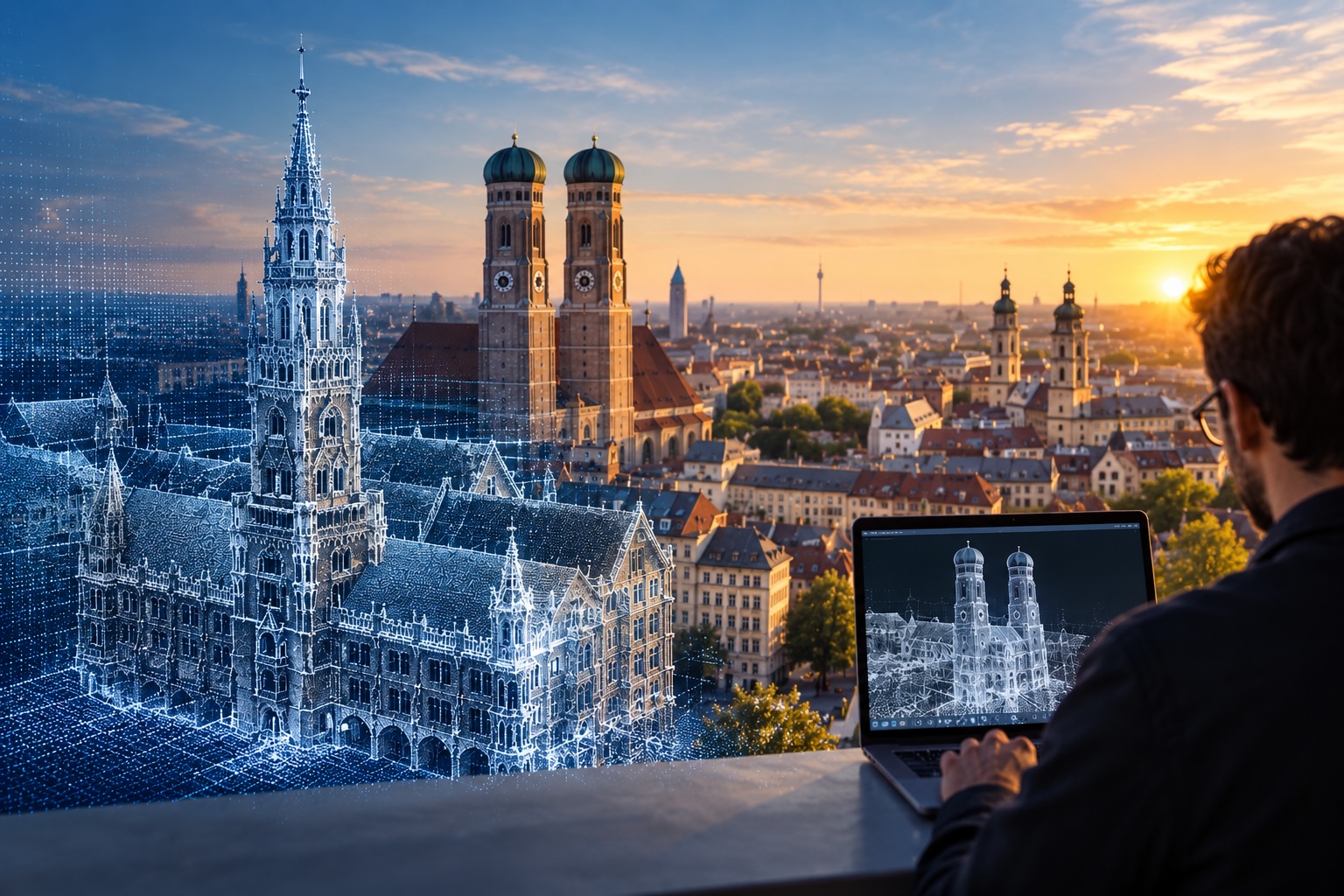
As Reality Data becomes a persistent operational asset, the real question is no longer how much cloud storage costs, but what organisations are actually paying for: data, processing, access, workflows or long-term value.
For years, the economics of point clouds were relatively simple. A survey was commissioned, data was acquired and processed, and a deliverable was handed over to the client. The point cloud was essentially the outcome of a project.That model is changing.
Reality Data is increasingly being kept online, revisited, shared across teams, connected to BIM and GIS, enriched with annotations and AI, and reused as part of operational Digital Twin workflows. The point cloud is no longer simply delivered. It is increasingly maintained. And when data becomes persistent, a new question emerges:
What should the customer actually pay for?
Ahead of INTERGEO 2026, GEOmedia has started putting this question to a selected group of companies working on cloud-based point-cloud and Reality Data platforms. The first answers already suggest that the market is moving away from a simple “pay for storage” logic, although not necessarily toward a single alternative model.
From file to persistent Reality Data
The real transition is not simply from local storage to cloud storage, being instead from a project file to a persistent information environment. Reality Data today may include point clouds, panoramic imagery, meshes, Gaussian splats, derived models and links to BIM, GIS or asset-management systems. Once these datasets remain accessible over time, they start to become part of the operational memory of an organisation.
That changes their economic meaning.
Storage capacity, processing, project access, users, collaboration, APIs, streaming and long-term maintenance can all become part of the value proposition, and the central question therefore becomes less technical and more strategic:
Is the customer paying for infrastructure, software capability, access to data, or the operational value created from that data?
The industry perspective
“The application should adapt to the customer's data infrastructure – not the other way around.”. This is the position of Nicole Herber, responsible for the product direction and further development of PointCab Nebula. For PointCab, pricing should be predictable and reflect the value of the software rather than primarily monetising storage or user access. Data control is equally important.
Since point clouds are large by nature and cloud storage is now a relatively inexpensive commodity, Nebula allows customers to use their own storage infrastructure and pay for project slots instead. Reality-capture data can retain value for years and may contain sensitive information, making control over storage and access part of the workflow itself. PointCab also sees point clouds evolving from temporary deliverables into persistent visual records of physical assets, connected to BIM models, documents and other information over the asset lifecycle.
Cintoo reaches a similar conclusion from a different starting point.
“Storage capacity isn’t where customers get value.” Dominique Pouliquen, CEO of Cintoo, told GEOmedia that users should ideally be unlimited to encourage adoption, while value is created above all through the processing of Reality Data and its use in day-to-day workflows. Cintoo also considers data ownership and full control of customer data in the cloud essential, and sees Reality Data platforms evolving beyond visualisation toward actionable data supporting Digital Twin workflows.
PointCab and Cintoo therefore start from different commercial models but reach a similar conclusion: the value of Reality Data cannot be reduced to storage costs. What matters increasingly is what organisations can do with that data over time — and how much control they retain over it.
GEOmedia is extending these questions across the geospatial ecosystem, engaging major industry players including Autodesk, RIEGL, Trimble, Terrasolid, u-blox, CHCNAV, Phase One, XGRIDS, ACCA, etc. The objective is to gather different perspectives on how Reality Data is evolving — from pricing and data ownership to interoperability, long-term access and its growing role in Digital Twin workflows.
An early consensus — and an important difference
The first two responses reveal an interesting pattern.
PointCab and Cintoo use different commercial and technical models, but both question the idea that storage volume should define the economic value of a Reality Data platform.
They also converge on another point:
Customers must retain control over their data.
Where they differ is in how they describe the main source of value. For PointCab, the emphasis is on software value, project-based access and customer-controlled infrastructure. For Cintoo, the emphasis is more strongly on processing and operational use.
This distinction may appear subtle, but it reflects a broader transformation in the market:
Reality Data platforms are no longer competing only on the basis of where data is stored, but on what users can actually do with it.
The question is becoming larger than pricing
Once Reality Data becomes persistent, pricing can no longer be separated from ownership, portability and long-term access.
What happens to the data after five or ten years? Can the customer move it to another environment? Can the original data still be accessed independently of the platform? What happens to annotations, measurements, links and derived information? How much of the value created inside a platform can be transferred elsewhere?
These are no longer purely IT questions.
They are becoming economic questions.
The more useful a platform becomes, the more important portability becomes. The more deeply Reality Data is integrated into daily operations, the more significant the risk of dependency on a single environment. This is also where the discussion begins to overlap with Digital Sovereignty.
GEOmedia has already opened a parallel discussion with con terra on the relationship between Digital Twins, GeoAI and sovereignty, while similar questions have also been submitted to NavVis, PIX4D and Prevu3D.
From project deliverable to operational memory
The evolution of Digital Twins reinforces this transition.
If Reality Data is used only as a one-time survey deliverable, its economic model can remain tied to a specific project. If, however, that same data becomes the geometric baseline of an operational Digital Twin, it must remain available, measurable, connected, updateable and reusable over time. The economic model therefore shifts from a one-off project logic toward a more continuous relationship between data, software and services.
This changes the financial logic as well. Costs once concentrated around individual survey and processing projects increasingly coexist with recurring expenditure for access, processing, software services, data management and the continuous maintenance of operational information.
This may ultimately be one of the most important changes taking place in the Reality Capture market.
GEOmedia is asking the industry
GEOmedia has submitted a common set of questions to a number of companies working in this field:
- What should customers primarily pay for when Reality Data becomes persistent?
- How important are ownership, portability and long-term control?
- Are Reality Data platforms becoming permanent infrastructures for Digital Twins and asset management?
The first answers from PointCab and Cintoo already indicate that the market is moving beyond a simple storage-based logic.
Further responses are expected ahead of INTERGEO, while GEOmedia will continue the discussion directly with technology providers in Munich.
A question to continue in Munich
The economics of Reality Data appear to be moving away from the simple cost of storing large files and toward the value created by processing, access, collaboration, integration and long-term operational use. At the same time, data ownership is emerging not as a secondary contractual issue, but as part of the economic value of the platform itself.
GEOmedia will continue this investigation at INTERGEO 2026 in Munich and will update this article after the event with further responses, observations and evidence from the market.
The central question remains open:
When the point cloud becomes part of the operational memory of an organisation, what exactly should the customer be paying for?
GEOmedia Road to INTERGEO 2026
This article is part of GEOmedia's Road to INTERGEO 2026, an editorial journey examining the technologies, workflows and business models that are reshaping the geospatial industry ahead of INTERGEO in Munich.
The investigation will continue at INTERGEO 2026. GEOmedia will meet technology providers and industry leaders in Munich to collect further answers on Reality Data, Digital Twins, GeoAI, data ownership and the evolving economics of geospatial platforms. This article will be updated after the event with new contributions and observations from the market.
Continue the Road to INTERGEO:
#01 Reality Capture Is Changing: From LiDAR and SLAM to Intelligent 3D Mapping
#02 GNSS Moves Beyond Surveying
#03 GeoAI Moves from Experimentation to Geospatial Workflows
#04 Digital Twins Need a Geospatial Foundation
Meet GEOmedia at INTERGEO 2026
15–17 September 2026 · Munich
Explore the GEOmedia Road to INTERGEO 2026 →
Free visitor voucher: IG26-GEOMEDIA



